Please note: This
course is in transition. The course code, title, units, and content may change in future.
Further information will be provided on the IHNA website when available, upon enrolment
and/or during the course of your training.
I am a
Domestic Student
Domestic Student
For the purpose of enrolment, IHNA considers you as a Domestic student if
you are an Australian citizen
a permanent resident of Australia
a New Zealand citizen, or
a holder of a permanent humanitarian visa, or
a temporary resident of Australia holding a valid visa of SC485 / SC482
public
Currently, enrolment for this course is limited to domestic students.
IHNA welcomes Aboriginal and Torres Strait Islander students and is committed to providing an inclusive and culturally respectful learning environment.
Pathology collectors play a crucial role in healthcare. They are responsible for
collecting blood and other specimens essential for diagnosing diseases and determining
treatments.Our Certificate III in Pathology Collection (HLT37215) offers a pathway to a rewarding
career in this essential field, where you can make a real difference in patient care.This nationally
accredited course combines practical skills with essential theoretical knowledge, ensuring that you
are well-prepared to work competently in various healthcare settings.
*Government Funding Applicable for Eligible Candidates
The Certificate III in Pathology Collection equips individuals with the
necessary skills required to collect, handle, and transport blood and other
specimens for diagnostic testing. The course covers areas such as specimen
collection techniques, infection control and effective communication with patients.
Graduates are prepared for roles as Pathology Collectors or Phlebotomists and can
work in different healthcare settings, such as private and public pathology centres,
hospitals, clinics, and client residences.
Choose Online Theory Classes
On-Campus Simulation Workshops
Professional Experience Placement
New batches starting bi-monthly
Morning and Evening Sessions Available
Flexible Learning: Online theory classes with on-campus
simulation
workshops.
Placement: Gain hands-on experience with
professional
placements.
Bi-Monthly Intakes: New batches starting bi-monthly.
Comprehensive Student Support: 24/7 access to resources,
personalised
guidance, and career support.
Industry Connections: Network with healthcare leaders and gain
real-world exposure.
State-of-the-Art Facilities: Train with the latest equipment in
modern
learning environments.
IHNA offers the HLT37215 – Certificate III in Pathology Collection.
This course is suitable for those seeking a career as a pathology collector or
phlebotomist.
Pathology collectors play an important role in healthcare by collecting
samples from patients for tests. These include blood, urine, faeces, sputum, swabs,
and other samples depending on the test required. Their duties include explaining
procedures to patients, following infection control protocols, and collecting
samples with minimal discomfort. They are responsible for accurately handling,
labelling, and preparing samples for testing, recording patient and specimen
details, maintaining and cleaning equipment, and communicating with patients to
provide reassurance and address any concerns. Additionally, after receiving further
training, pathology collectors may perform Electrocardiograms (ECGs), manage Holter
monitors (portable devices for tracking heart rhythms), and conduct blood pressure
monitoring.
⚠️ Important Notice – Western Australia
Government Funding
Western Australia government funding for this
course has been fully exhausted for now.
Please contact our admissions team to explore
alternative options or flexible payment
plans.
If the student is eligible for
government funding, the student pays $1,300.86.
If the student holds a valid concession card,
the student pays $385.44*.
Western Australia funded seats are
subject to availability and
approval
*This training is delivered
under the Jobs and Skills WA program
*The Student tuition fees are
indicative only and are subject to
change given individual circumstances at
enrolment. Additional fees may apply
such as Student service and resource
fees
Refer to the “DTWD Funded Training”
eligibility guidelines to check your
funding eligibility. Click
here.
To know more about the IHNA Fees &
Charges,
click here
Smart and Skilled funding is
available for eligible students in
NSW*.
Important
notice — Smart and Skilled funding
update
Our Smart and Skilled funding
allocation is currently reserved for
continuing students only. New
student enrolments under this
funding stream are not available at
this time.
To know more about the IHNA Fees &
Charges,
click here
We would like to inform you about a
recent
surge in cyber
scams. Your security is of utmost importance to us,
and
we
want to ensure
that you stay safe from potential threats.
Scammers have been employing
sophisticated
tactics to deceive
individuals and steal sensitive information. It’s
essential
to be vigilant
and cautious when dealing with online communications
and
transactions.
For IHNA’s students, it’s good to know
that
IHNA’s bank account
details are not shared through email. Instead, the
information is accessible
through the secure Student Hub
under
Student Invoice
& Payment. This method ensures that only
authorised
users with secure
login credentials can access and view the
information.
Additionally, making payments through
the
IHNA website
provides
another secure option for
transactions, ensuring that personal and financial
details
are handled in a
safe and protected environment.
For any questions or concerns related
to
payments or account
details, students should reach out to IHNA directly
through
official contact
channels (accounts@ihna.edu.au)
to ensure the highest level of
security and privacy.
(Blended: online
real time
theory tutorials with on campus skills training in a simulation
environment)
20 contact hours will be delivered through synchronised online
learning
which includes on- campus simulation based training and Professional
experience
placement.
Besides the above structured learning, students are advised
that they
will be required to do approximate 10 hours per week of unstructured
self-learning.
The delivery mode is subject to your eligibility to access
state
funding requirements and other conditions, please contact our admissions
consultants
to know more.
(For Jobs and Skills WA Training program requirement only)
Institute of Health and Nursing Australia (IHNA) will
deliver minimum 3 days of on-campus classes on a weekly basis. Students must
participate in 24 hours of scheduled course contact hours weekly. During
these classes, students attend theory, on-campus simulation-based
assessments and learning, which are a requirement of the Western
Australia Department of Training and Workforce Development.
Professional Experience Placement (PEP) is a mandatory component of the
Certificate III in Pathology Collection qualification. IHNA provides PEP for all
students who meet the required criteria outlined in the Entry Requirements. Students
are required to complete 35 hours of practical placement under the supervision of a
workplace supervisor at an approved facility.
During the PEP, students will apply essential knowledge and skills to demonstrate
competency in each unit of the qualification. An IHNA trainer and assessor will
monitor the student’s progress throughout the PEP. While IHNA arranges all PEPs.
Want to know more about IHNA’s clinical and industry partners? Click here
Note: IHNA will arrange placements for
students, aiming to keep them as close to their suburbs as possible. However,
there may be occasions when this isn’t feasible, resulting in longer travel
distances than expected. If a student fails to meet the PEP requirements, they
may be excluded from placement, and IHNA will not be held responsible for such
exclusions.
There are no mandatory entry requirements for this course; however,
following IHNA admission criteria will be applicable:
IHNA Admission Requirements
18 years of age and above at the time of commencement of the course*
Successful completion of an Australian Year 10 qualification or
equivalent
In addition to meeting the educational requirements applicants must
demonstrate their competence in literacy and numeracy levels in an
Australian Core Skills Framework (ACSF) at exit Level 3 and participate
in a pre-training review when enrolling into the course.
*Mature age students (22+) will also be considered
without the minimum education requirements. Each case will be reviewed
individually to ascertain the capacity of the student to meet course
requirements.
Note: Aboriginal and Torres Strait Islander students are
encouraged to apply.
Language, Literacy, Numeracy and Digital (LLND)
All IHNA students must complete the Language, Literacy,
Numeracy, and
Digital (LLND) assessment to ensure that students meet the necessary
requirements
for successfully undertaking the course. IHNA administers the LLND test to
evaluate
each student’s suitability.
Digital Literacy
Students should possess basic computer skills covering the
most
common usages of a computer, including managing computer files, word
processing, using spreadsheets and databases; creating presentations;
finding information and communicating using computers; and being aware
of
social and ethical implications of Internet use.
Students should be in possession of their own laptops to
facilitate the training and assessment.
Professional Experience Placement (PEP)
Requirements
A National Police Clearance or Australian Federal Police (AFP) Clearance
certificate
Immunisation prior to undertaking Professional Experience Placement
(PEP) in healthcare facilities
Declaration of having a disability, disorder, or on any medication that
will need reasonable adjustments to fulfil these requirements
Working with Children Check (WWCC): Students may have the opportunity to
work with patients under the age of 18. Before students are allowed to
contact with minors, students need to obtain a WWCC check.
Our approach is to collect evidence on whether the student can
perform
to the standards of the workplace. This is based on the relevant unit of
competency,
and you’ll find these tools being used:
Theory Assessments (TA)
Knowledge Based Assessments (KBA)
Simulation Based Assessments (SBA)
Professional Experience Placement (PEP)
Recognition of Prior Learning (RPL)
With RPL we assess your competency based on formal, non-formal,
informal learning or direct work experience based on the required skills of
the
course.
Credit Transfer(CT)
We use CT where you’ve completed units of study at another TAFE
College
or Registered Training Organisation that meet the requirements of another
course. We
grant credit according to the Certification, Issuing, and Recognition of
Qualifications and Statements of Attainment. Assessing a CT is free.
If you’re eligible for RPL or CT you may be able to complete
the
course
in a shorter duration with reduction to total course fees. Check
your eligibility with us.
Application: Submit your online application by clicking “Enrol
Now”
on
the top right corner of the course page.
Interview: Once you’ve met IHNA’s eligibility criteria you will
be
contacted for an interview with an admissions consultant
Offer Letter: If you’re successful with the interview you will be
offered
a place for the course as per the availability of each intake.
Enrolment Fee: After signing the offer acceptance an invoice will
be
issued for the course. You may be eligible for government funding, so
please
call our team to know more.
Confirmation of Admission: We will issue a conformation of
admission
once
the enrolment fee has been received.
Call us on 1800 22 52 83 for any
questions
regarding your application.
How long it will take to complete this course?
The course is designed to be completed in 670 hours. Course
extensions may be available, subject to conditions and after discussion with
the course coordinator.
Do I need any prior qualifications to enrol in this course?
No prior qualifications are required to enrol, though some
basic knowledge in healthcare may be helpful.
What resources or materials will I need for the course?
Having access to a computer or laptop is typically essential
for completing online modules, accessing course materials, and participating
in virtual classes or discussions. All other required learning materials,
including online resources and equipment for practical exercises, will be
provided by IHNA.
What should I do if I miss a class or need extra help during the
course?
If you miss a class or need extra assistance, you can contact
your trainer or access support services to catch up on missed content and
receive additional guidance.
Can I complete the course fully online?
No, the course is not available fully online. It is delivered
in a blended mode for both domestic and international students.
What is blended mode of delivery?
Blended mode of delivery combines both online and in-person
learning. Students will complete a portion of their study online, through
digital materials and virtual classrooms, while also attending in-person
classes or practical sessions for hands-on experience. This mode allows
flexibility for students to manage their learning and practical training.
Is there any pre-recorded session available?
Yes, pre-recorded sessions are available to help you review
content at your own pace.
How long it will take to mark my assessments?
Assessments are typically marked within 14 days of submission.
Do I get another chance if I fail the assessments?
Yes, if you fail an assessment, you will be given the
opportunity to reattempt it, subject to conditions and after discussing it
with your trainer and course coordinator.
I have already studied and received competency for some of the units in the
course. Will I need to study them again?
If you have previously completed and achieved competency in
units that are part of this course, you are eligible for a credit transfer.
The credit transfer process will verify that your prior studies meet the
necessary course standards, and if approved, you will not need to repeat the
units.
What is RPL, and can I apply for it?
RPL (Recognition of Prior Learning) is a process that
recognises your existing skills and knowledge gained through work, life
experience, or previous studies. If you meet the RPL requirements, you can
apply to have these competencies formally recognised, potentially reducing
the amount of study needed for your course.
Does each campus in Brisbane, Sydney, Melbourne, and Perth have the same
simulation-based assessment facilities?
Yes, IHNA campuses provide industry-standard simulated labs
with all necessary equipment for Certificate III in Pathology
Collection training.
How will I learn blood collection (venepuncture) during the course?
You will learn blood collection (venepuncture) by first
practicing on a dummy arm to develop your technique. Following this, you
will participate in reciprocal live blood collection sessions, performing a
minimum of 20-25 live bleeds on fellow students under supervision. This
hands-on experience ensures you gain the necessary skills and confidence for
performing venepuncture in a real-world setting.
What support is available during the course?
IHNA offers 24/7 student support to help you throughout your
studies. Whether you require academic guidance, technical assistance, or
have course-related questions, support is available anytime to help you
succeed. Weekly support sessions are also offered for students who need
additional help.
What are the document requirements for Professional Experience Placement
(PEP)?
Current police check
Proof of immunisation
Working with Children Check
Are there any uniform requirements for placements?
Yes, there are uniform requirements for placements. Students
are typically required to wear a professional uniform and any additional
requirements specified by the placement provider. Specific details will be
provided by IHNA, and it’s important to adhere to the dress code to ensure
safety and professionalism during your placement. Students can either
purchase the uniform from IHNA or arrange it themselves.
What happens if I don’t participate in or fail to attend my professional
placement?
Professional placement is a mandatory requirement of the
course. Failure to complete it will result in unsuccessful course completion
and ineligibility for the qualification. If a student fails to attend or
withdraws from a scheduled placement without a valid reason, they will be
liable for the placement costs, which range from $350 to $500.
How long does it take to issue a certificate?
After the completion of the placement and submission all
required assessments and documents, IHNA will issue the certificate within
30 days.
The Certificate III in Pathology Collection equips
individuals with the
necessary skills required to collect, handle, and transport blood and
other
specimens for diagnostic testing. The course covers areas such as
specimen
collection techniques, infection control and effective communication
with patients.
Graduates are prepared for roles as Pathology Collectors or
Phlebotomists and can
work in different healthcare settings, such as private and public
pathology centres,
hospitals, clinics, and client residences.
IHNA offers the HLT37215 – Certificate III in Pathology
Collection. This course is suitable for those seeking a career as a
pathology collector or phlebotomist.
Pathology collectors play an important role in healthcare
by collecting samples from patients for tests. These include blood,
urine, faeces, sputum, swabs, and other samples depending on the test
required. Their duties include explaining procedures to patients,
following infection control protocols, and collecting samples with
minimal discomfort. They are responsible for accurately handling,
labelling, and preparing samples for testing, recording patient and
specimen details, maintaining and cleaning equipment, and communicating
with patients to provide reassurance and address any concerns.
Additionally, after receiving further training, pathology collectors may
perform Electrocardiograms (ECGs), manage Holter monitors (portable
devices for tracking heart rhythms), and conduct blood pressure
monitoring.
⚠️ Important Notice – Western Australia
Government Funding
Western Australia government funding for this
course has been fully exhausted for now.
Please contact our admissions team to explore
alternative options or flexible payment
plans.
If the student is
eligible for
government funding, the student pays
$1,300.86.
If the student holds a valid
concession card,
the student pays
$385.44*.
Western Australia funded
seats are subject to
availability and
approval
*This training is
delivered under the Jobs and
Skills WA program
*The Student
tuition fees are
indicative only and are
subject to
change given individual
circumstances at
enrolment. Additional fees
may apply
such as Student service and
resource
fees
Refer to the “DTWD Funded
Training”
eligibility guidelines to
check your
funding eligibility. Click
here.
To know more about the IHNA Fees
&
Charges,
click here
Smart and Skilled
funding is
available for eligible students in
NSW*.
Important notice — Smart
and Skilled funding
update
Our Smart and Skilled
funding allocation is
currently reserved for
continuing students
only. New student
enrolments under this
funding stream are not
available at this time.
To know more about the IHNA Fees
&
Charges,
click here
We would like to inform you about a
recent
surge in cyber
scams. Your security is of utmost importance to
us,
and
we
want to ensure
that you stay safe from potential threats.
Scammers have been employing
sophisticated
tactics to deceive
individuals and steal sensitive information.
It’s
essential
to be vigilant
and cautious when dealing with online
communications
and
transactions.
For IHNA’s students, it’s good to
know
that
IHNA’s bank account
details are not shared through email. Instead,
the
information is accessible
through the secure Student
Hub
under
Student Invoice
& Payment. This method ensures that only
authorised
users with secure
login credentials can access and view the
information.
Additionally, making payments
through
the
IHNA
website
provides
another secure option for
transactions, ensuring that personal and
financial
details
are handled in a
safe and protected environment.
For any questions or concerns
related
to
payments or account
details, students should reach out to IHNA
directly
through
official contact
channels (accounts@ihna.edu.au)
to ensure the highest level of
security and privacy.
(Blended:
online
real time
theory tutorials with on campus skills training in a simulation
environment)
20 contact hours will be delivered through synchronised
online
learning
which includes on- campus simulation based training and Professional
experience
placement.
Besides the above structured learning, students are advised
that they
will be required to do approximate 10 hours per week of unstructured
self-learning.
The delivery mode is subject to your eligibility to access
state
funding requirements and other conditions, please contact our admissions
consultants
to know more.
(For Jobs and Skills WA Training program requirement only)
Institute of Health and Nursing Australia (IHNA) will
deliver minimum 3 days of on-campus classes on a weekly basis.
Students must
participate in 24 hours of scheduled course contact hours weekly.
During
these classes, students attend theory, on-campus simulation-based
assessments and learning, which are a requirement of the Western
Australia Department of Training and Workforce Development.
Professional Experience Placement (PEP) is a mandatory component
of the
Certificate III in Pathology Collection qualification. IHNA provides
PEP for all
students who meet the required criteria outlined in the Entry
Requirements. Students
are required to complete 35 hours of practical placement under the
supervision of a
workplace supervisor at an approved facility.
During the PEP, students will apply essential knowledge and skills to
demonstrate
competency in each unit of the qualification. An IHNA trainer and
assessor will
monitor the student’s progress throughout the PEP. While IHNA arranges
all PEPs.
Want to know more about IHNA’s clinical and industry partners? Click here
Note: IHNA will arrange
placements for
students, aiming to keep them as close to their suburbs as possible.
However,
there may be occasions when this isn’t feasible, resulting in longer
travel
distances than expected. If a student fails to meet the PEP
requirements, they
may be excluded from placement, and IHNA will not be held
responsible for such
exclusions.
There are no mandatory entry requirements for this course; however,
following IHNA admission criteria will be applicable:
IHNA Admission Requirements
18 years of age and above at the time of commencement of the course*
Successful completion of an Australian Year 10 qualification or
equivalent
In addition to meeting the educational requirements applicants must
demonstrate their competence in literacy and numeracy levels in an
Australian Core Skills Framework (ACSF) at exit Level 3 and
participate
in a pre-training review when enrolling into the course.
*Mature age students (22+) will also be
considered
without the minimum education requirements. Each case will be reviewed
individually to ascertain the capacity of the student to meet course
requirements.
Note: Aboriginal and Torres Strait Islander students are
encouraged to apply.
Language, Literacy, Numeracy and
Digital (LLND)
All IHNA students must complete the Language, Literacy,
Numeracy, and
Digital (LLND) assessment to ensure that students meet the necessary
requirements
for successfully undertaking the course. IHNA administers the LLND test
to
evaluate
each student’s suitability.
Digital Literacy
Students should possess basic computer skills covering
the
most
common usages of a computer, including managing computer files, word
processing, using spreadsheets and databases; creating
presentations;
finding information and communicating using computers; and being
aware
of
social and ethical implications of Internet use.
Students should be in possession of their own laptops
to
facilitate the training and assessment.
Professional Experience Placement (PEP)
Requirements
A National Police Clearance or Australian Federal Police (AFP)
Clearance
certificate
Immunisation prior to undertaking Professional Experience Placement
(PEP) in healthcare facilities
Declaration of having a disability, disorder, or on any medication
that
will need reasonable adjustments to fulfil these requirements
Working with Children Check (WWCC): Students may have the
opportunity to
work with patients under the age of 18. Before students are allowed
to
contact with minors, students need to obtain a WWCC check.
Our approach is to collect evidence on whether the student
can
perform
to the standards of the workplace. This is based on the relevant unit of
competency,
and you’ll find these tools being used:
With RPL we assess your competency based on formal,
non-formal,
informal learning or direct work experience based on the required skills
of
the
course.
Credit Transfer(CT)
We use CT where you’ve completed units of study at another
TAFE
College
or Registered Training Organisation that meet the requirements of
another
course. We
grant credit according to the Certification, Issuing, and Recognition of
Qualifications and Statements of Attainment. Assessing a CT is free.
If you’re eligible for RPL or CT you may be able to
complete
the
course
in a shorter duration with reduction to total course fees. Check
your eligibility with us.
Application: Submit your online application by clicking
“Apply Now” on the top right corner of the course page.
Interview: Once you’ve met IHNA’s eligibility criteria you
will be contacted for an interview with an admissions consultant
Offer Letter: If you’re successful with the interview you
will be offered a place for the course as per the availability of
each intake.
Enrolment Fee: After signing the offer acceptance an invoice
will be issued for the course. You may be eligible for government
funding, so please call our team to know more.
Confirmation of Admission: We will issue a conformation of
admission once the enrolment fee has been received.
Call us on 1800 22 52 83 for
any
questions
regarding your application.
The course is designed to be completed in 670 hours. Course
extensions may be available, subject to conditions and after
discussion with
the course coordinator.
Having access to a computer or laptop is typically essential
for completing online modules, accessing course materials, and
participating
in virtual classes or discussions. All other required learning
materials,
including online resources and equipment for practical
exercises, will be
provided by IHNA.
If you miss a class or need extra assistance, you can contact
your trainer or access support services to catch up on missed
content and
receive additional guidance.
Blended mode of delivery combines both online and in-person
learning. Students will complete a portion of their study
online, through
digital materials and virtual classrooms, while also attending
in-person
classes or practical sessions for hands-on experience. This mode
allows
flexibility for students to manage their learning and practical
training.
Yes, if you fail an assessment, you will be given the
opportunity to reattempt it, subject to conditions and after
discussing it
with your trainer and course coordinator.
If you have previously completed and achieved competency in
units that are part of this course, you are eligible for a
credit transfer.
The credit transfer process will verify that your prior studies
meet the
necessary course standards, and if approved, you will not need
to repeat the
units.
RPL (Recognition of Prior Learning) is a process that
recognises your existing skills and knowledge gained through
work, life
experience, or previous studies. If you meet the RPL
requirements, you can
apply to have these competencies formally recognised,
potentially reducing
the amount of study needed for your course.
You will learn blood collection (venepuncture) by first
practicing on a dummy arm to develop your technique. Following
this, you
will participate in reciprocal live blood collection sessions,
performing a
minimum of 20-25 live bleeds on fellow students under
supervision. This
hands-on experience ensures you gain the necessary skills and
confidence for
performing venepuncture in a real-world setting.
IHNA offers 24/7 student support to help you throughout your
studies. Whether you require academic guidance, technical
assistance, or
have course-related questions, support is available anytime to
help you
succeed. Weekly support sessions are also offered for students
who need
additional help.
Yes, there are uniform requirements for placements. Students
are typically required to wear a professional uniform and any
additional
requirements specified by the placement provider. Specific
details will be
provided by IHNA, and it’s important to adhere to the dress code
to ensure
safety and professionalism during your placement. Students can
either
purchase the uniform from IHNA or arrange it themselves.
Professional placement is a mandatory requirement of the
course. Failure to complete it will result in unsuccessful
course completion
and ineligibility for the qualification. If a student fails to
attend or
withdraws from a scheduled placement without a valid reason,
they will be
liable for the placement costs, which range from $350 to $500.
Sri Lanka to Australia – Nishanthi’s Inspiring Journey in Australia
I came to Australia with the sole focus of providing better opportunities for me and my
family. On the way, I discovered a purposeful career. I’ve tried my hand in many industries,
but it’s nursing that stuck with me the most. A career in nursing aligned with my core
values of caring for others and service. It fulfilled my intellectual appetite for working
in the medical field.
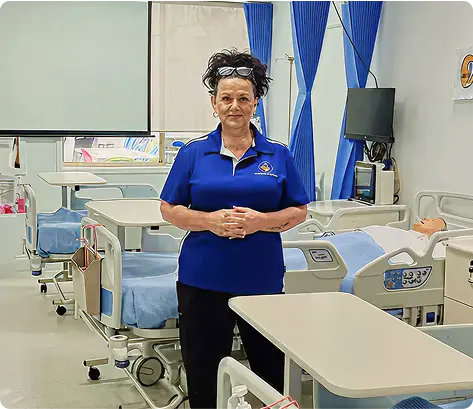
How IHNA Empowered Paula Baglieri to Pursue Her Nursing Dream
After years of exploring various industries, Paula Baglieri discovered her true calling: a
rewarding and profoundly impactful career. Her passion for healthcare and dedication to
helping others ignited her interest in nursing, driving her to find the right educational
pathway. That’s when she saw the Diploma of Nursing at IHNA, a program designed to provide
hands-on training, invaluable industry exposure, and a solid foundation for a prosperous
future in healthcare.
Get an answer on courses, costs, careers as well as facilities, entry
requirements or just about anything else relating to studying at IHNA. We are here to help
you
Flexible EveningClasses Available
Download Brochure/Handbook
Acknowledgement
IHNA acknowledges the Traditional Owners of the country throughout Australia and recognises continuing connection to land, waters, and culture. We pay our respects to Elders past, present and emerging.